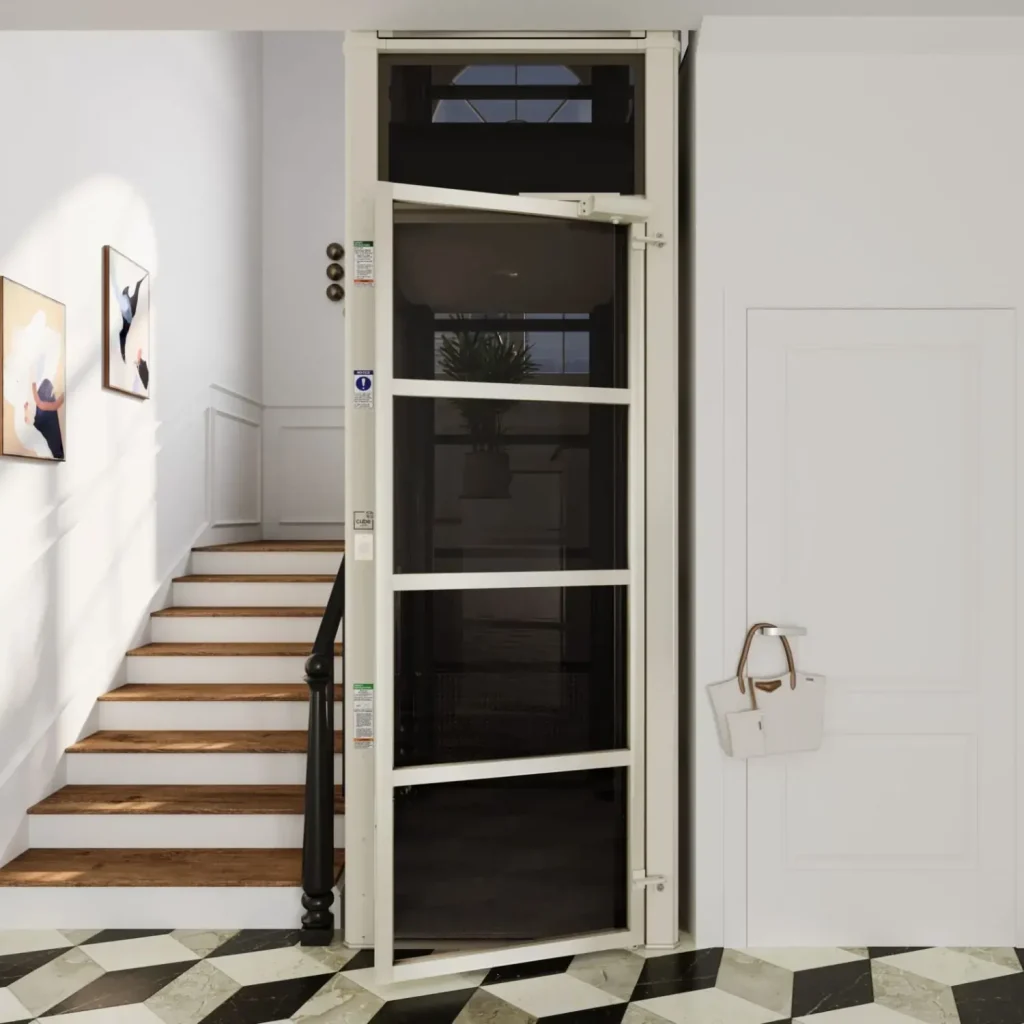

Home Elevator vs. Platform Lift
Home Elevator vs. Platform Lift: Which Is Right for You?
Both a home elevator and a platform (wheelchair) lift move you between floors — but they solve different problems, for different homes and different mobility needs. Here’s how to tell which one fits yours.
The Core Difference
A home elevator is a fully enclosed cab that travels inside a shaftway (or, for pneumatic vacuum models, a self-supporting cylinder). It’s a permanent structural addition to your home, requires an Oregon-licensed elevator mechanic to install, and needs a permit.
A platform lift carries a wheelchair or scooter user on an open or semi-enclosed platform, typically along an existing stairway or a shorter vertical rise. It generally involves less structural work than an elevator.
Who Tends to Need a Platform Lift
- You use a wheelchair or scooter and need to stay seated for the entire ride — a stair lift’s seat transfer isn’t an option.
- The rise you need to cover is short — porch steps, a garage-to-house entry, or a split-level change, rather than a full story.
- You want a solution with less structural work than a full elevator installation.
Who Tends to Need a Home Elevator
- You’re moving between full stories in a multi-story home, not just a short rise.
- You want a permanent, whole-home accessibility solution — especially if you’re planning to age in place long-term.
- You want the enclosed cab, finish options, and higher capacity a platform lift isn’t designed for.
Cost & Installation, Side by Side
Neither product has a single fixed price — both depend on your home’s structure — but as a general rule in the mobility equipment industry, platform lifts tend to involve less construction than home elevators and are typically the lower-cost option of the two. Home elevators require an Oregon permit and a licensed elevator mechanic in every case; platform lift permit requirements depend on the specific installation, so we’ll confirm what applies to your project during your in-home consultation.
Space & Structural Requirements
Platform lifts need a clear vertical run and a landing pad at top and bottom, but don’t require a full shaftway.
Home elevators need either a dedicated shaftway (hydraulic and cable-driven models) or the footprint for a self-supporting cylinder (pneumatic vacuum models) — generally a larger commitment of space.
Quick Comparison
- Mobility need: wheelchair/scooter user who must stay seated → platform lift. Multi-floor whole-home access → home elevator.
- Distance covered: short rise (a few steps, split-level) → platform lift. Full story or more → home elevator.
- Structural scope: platform lift is generally less invasive; a home elevator is a bigger, more permanent build.
- Timeline: platform lifts are typically faster to install than a home elevator, which involves permitting and possible shaftway construction.
See Both Product Lines
Home Elevators buying guide • Platform Lift category • Elevator category
Frequently Asked Questions
As a general rule across the industry, stair lifts are the lowest-cost option, platform lifts fall in the middle, and home elevators are the largest investment — though your exact cost depends on your home’s layout in every case.
It depends on the specific installation. Home elevators always require an Oregon permit and a licensed elevator mechanic; we’ll confirm what’s needed for a platform lift during your in-home consultation.
Some platform lift models are built for outdoor use. Tell us about your entryway and we’ll help you find a model suited to it.
That’s what the in-home consultation is for — we’ll look at your staircase or entryway, talk through your mobility needs, and recommend the right product rather than the one that’s easiest to sell.
Talk to a Local Specialist
Not sure which is the right fit? Call (503) 255-5005 or request a free in-home consultation. We serve Portland, Beaverton, Hillsboro, Gresham, Lake Oswego, and Tigard.
Get in touch
We’re here to listen, assist, and guide you; connect with us today and let’s make mobility a seamless experience together.
12833 NE Airport Way, Portland, OR 97230
sales@allinonemobility.com
Phone : 503-255-5005
Toll Free: 800-944-4935